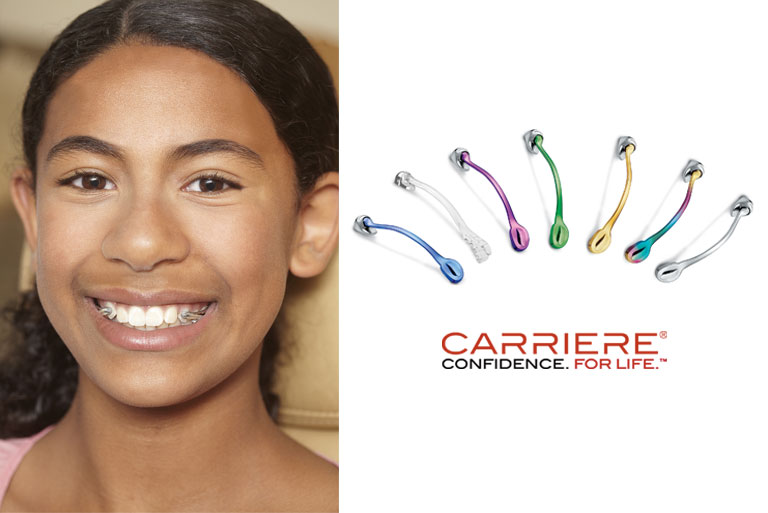
Carriere Motion is a small fixed appliance orthodontists use at the start of treatment when the upper teeth sit too far forward compared with the lower ones. It’s often combined with clear aligners, which is why more and more aligner patients hear about it.
Here’s what it is, how it works, what research shows and what to ask if your orthodontist suggests it.
Contents
What is the Carriere Motion appliance?
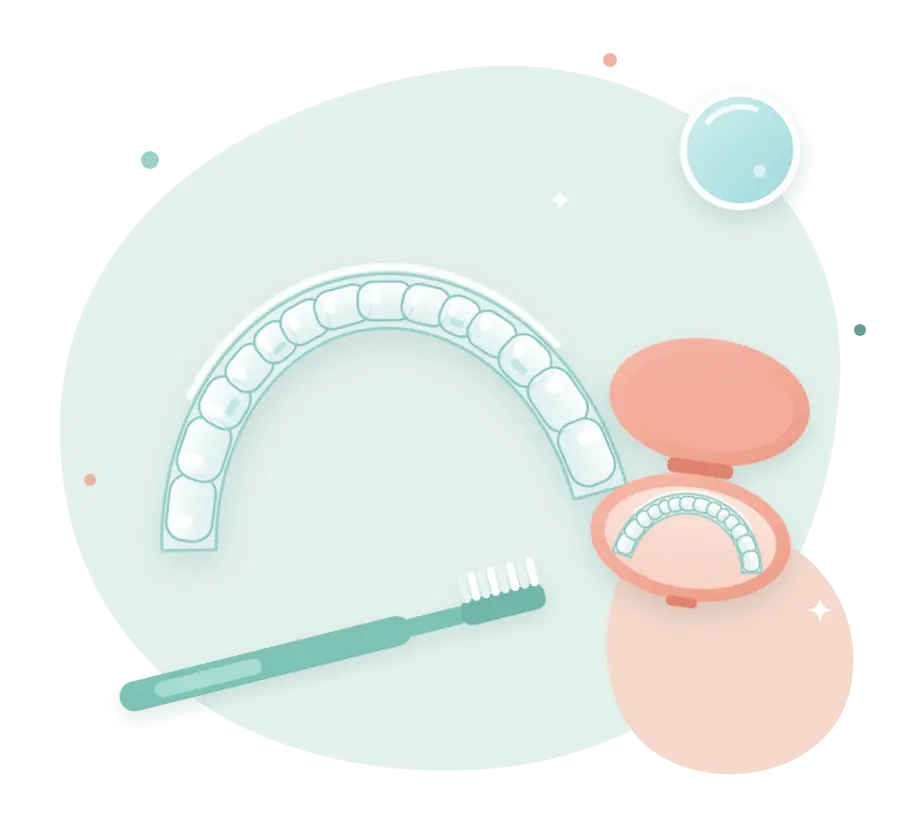
It’s a small metal bar bonded to the outside of the upper teeth on each side – from the canine to the first molar. Elastics are hooked onto it and run down to the lower molars. To stop the lower teeth from moving, you wear a clear retainer on the lower teeth (it looks like an aligner), braces or your lower aligner.
It’s mainly used for a Class II bite – when the upper teeth are too far forward compared with the lower ones. It’s the first stage of treatment: usually worn for 3 to 5 months, after which treatment continues with braces or aligners. Sometimes the two run at the same time.
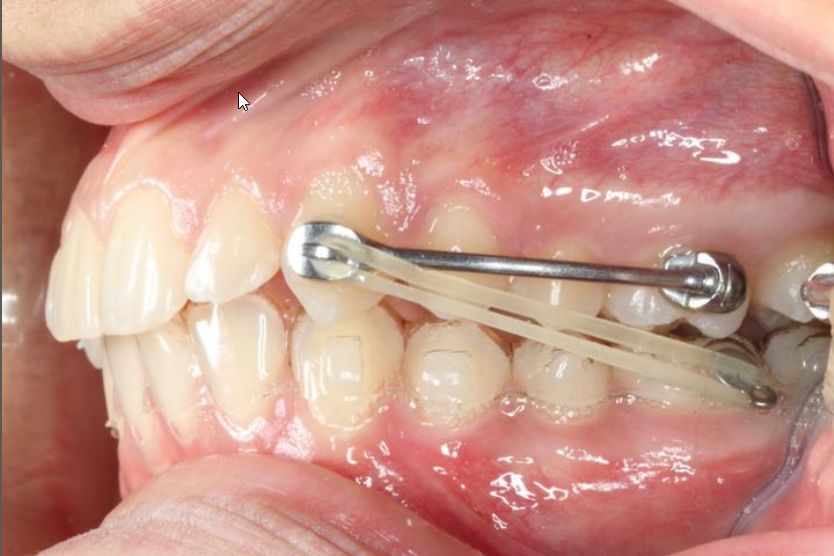
The appliance only works with the elastics. They’re worn at least 22 hours a day – without them, the appliance just sits on your teeth.
How does Carriere Motion work?
The elastics pull the upper back teeth (molars and premolars) backwards as one unit and rotate them slightly into the right position. At the same time, the lower teeth move forward a little. This lines up the back teeth, and then braces or aligners finish the job. The principle is the same as elastics with aligners, except that here the upper teeth move together, as a block.
What does research show about Carriere Motion?
A 2021 review of 16 studies reached several conclusions:
- the jaws don’t change – the effect is entirely on the teeth and the bone around them;
- the bite at the back improves – the upper molars move back and the lower ones forward;
- the lower front teeth tip forward – a common side effect of elastics, which is why the orthodontist keeps an eye on the lower anchorage;
- at follow-up several years later there’s a little relapse of the bite – so retainers matter here too.
The authors stress that the evidence is limited and better studies are needed. Claims often seen in adverts – that the appliance “halves treatment time” or “replaces surgery” – are not supported by comparative studies. When the problem lies in the jaw itself rather than the teeth, the appliance can’t fix it.
Carriere Motion and clear aligners
The combination is popular: the appliance fixes the bite at the back, while the aligners straighten the teeth. The photo above shows exactly this kind of hybrid case – the appliance on the upper teeth and an aligner on the lower ones, which also anchors the elastics.
With aligners alone, your orthodontist has other ways to achieve a similar movement – elastics with buttons or mini implants, which anchor in the bone. Which option suits you best depends on your case.
Pros and cons
| Pros | Cons |
|---|---|
| small and more discreet than many other bite appliances | elastics have to be worn almost constantly |
| a short stage – usually 3–5 months | the lower front teeth tip forward |
| works in combination with aligners | doesn’t change the jaws – only the teeth |
| the lower retainer or aligner comes out for brushing | harder to clean around the bonded part |
Everyday life with Carriere Motion
- wear the elastics at least 22 hours a day, taking them off only to eat and brush;
- never wear the elastics without your lower retainer or aligner (or braces) – without them, the elastics pull the lower teeth forward and out of line;
- avoid very hard and sticky foods that could debond the appliance;
- clean carefully around the bonded part – more in brushing your teeth with aligners;
- if the appliance comes off or your lower retainer doesn’t fit properly, stop the elastics on both sides and call your orthodontist – more in when to call your orthodontist.
Is Carriere Motion right for me?
Only an orthodontist can tell, after an examination and X-rays. If yours suggests it, ask:
- Is the problem in my teeth or in my jaw?
- How long will this stage take, and what comes next?
- What are the alternatives – elastics with aligners only, mini implants, another appliance?
- How will you stop my lower front teeth tipping too far forward?
For children who are still growing, orthodontists may suggest other appliances that influence jaw growth – more in two-phase orthodontic treatment. And how to choose a specialist is in how to choose an orthodontist.
Sources
- Barakat D., Bakdach W. M. M., Youssef M. (2021). Treatment effects of Carriere Motion Appliance on patients with class II malocclusion: a systematic review and meta-analysis. International Orthodontics.
- Orthodontic Update – How to effectively and efficiently use the Class II Carriere Motion appliance.
- Carriere Motion Appliance – patient instructions (orthodontic practice, 2024).
- Carriere System – official website.

Leave a Reply
You must be logged in to post a comment.