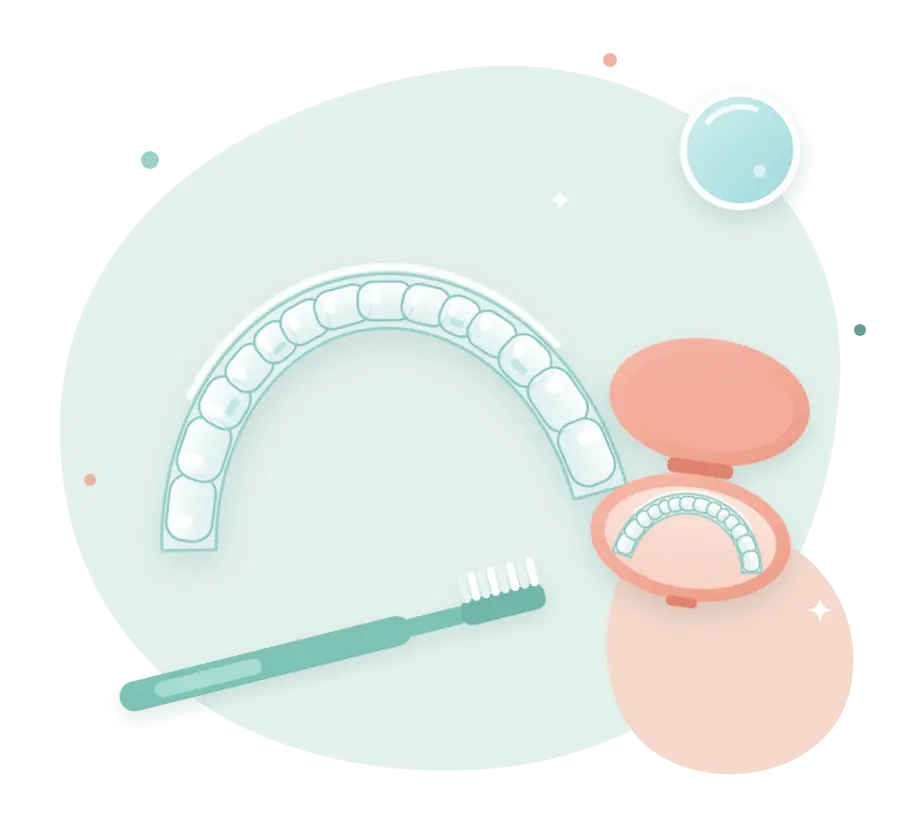

Aligner elastics and buttons – what are they actually for? Not everyone needs them, but if your bite needs fixing, you’ll almost certainly get some. I wore them for most of my 3.5 years with Invisalign, so here’s everything I learned – from how to put them on (my first one took 20 minutes 😅) to how often to change them.
In short: aligners on their own are good at moving individual teeth, but to shift your whole bite – one jaw relative to the other – they need help. That’s exactly what elastics do. And yes, thanks to them, aligners can fix bites too, not just “simple cases” – more on that myth in aligners vs braces. For bigger bite corrections, some orthodontists start with a small fixed appliance that works with elastics – the Carriere Motion appliance.
Contents
What are aligner elastics?
Tiny rubber bands, the same ones used with braces. They come in different lengths, thicknesses, materials and strengths, and your orthodontist picks exactly the ones you need. They hook between your upper and lower jaw to pull one forward or back, close an open bite or help move a particular tooth.
I wore two elastics to correct my bite – one on each side – and for a while a third one to move one specific tooth.
Most aligner elastics are made of latex. If you’re allergic to latex, tell your orthodontist: there are latex-free ones that do exactly the same job.
What are buttons?
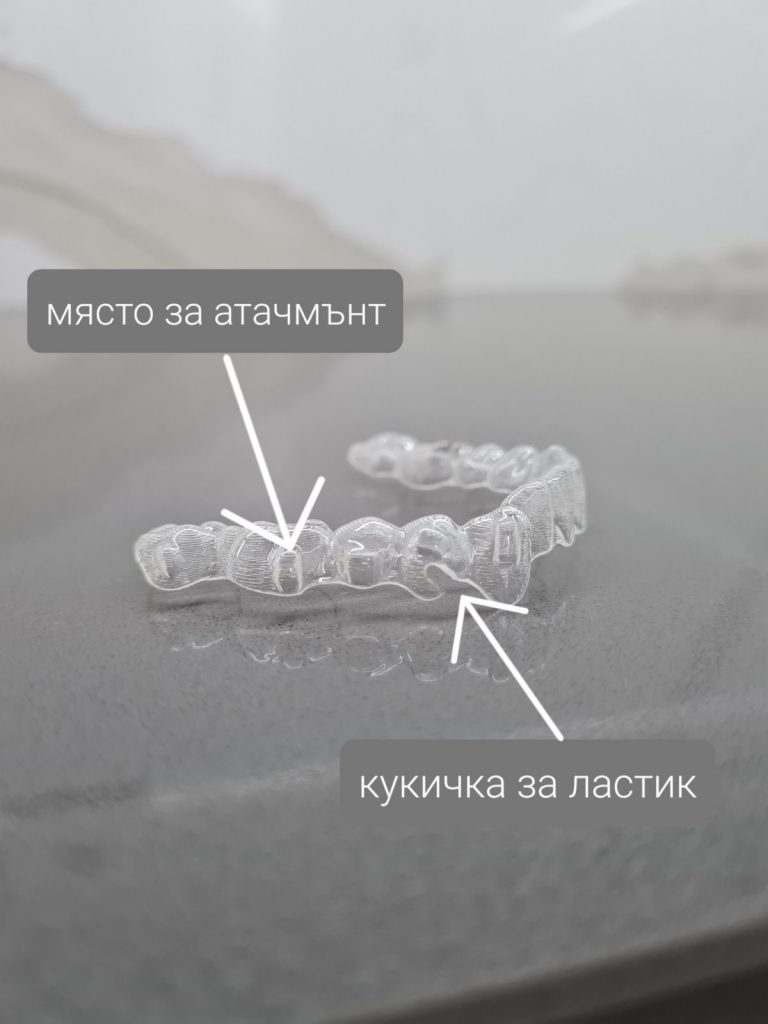
Buttons are small studs bonded onto a tooth for the elastic to hook onto. Wherever there’s a button, the aligner has a cut-out. Unlike attachments, which sit under the tray, buttons poke out through the cut-out.
| Metal | Tooth-coloured (composite) | |
|---|---|---|
| Visibility | silver, but small and discreet | match your teeth |
| Size | smaller, don’t stick out much | bigger and bulkier |
| How well they stay on | better | come off more often |
Tooth-coloured buttons blend in, but they have a smaller bonding base and mine came off quite often and easily. So if you get a choice, I’d go for metal ones, even though they’re not tooth-coloured. It’s not worth trekking to the orthodontist every time one pops off.

If you get a choice, ask for metal buttons. They’re small, barely noticeable and come off far less often than tooth-coloured ones.
Where do the elastics hook on?
Usually aligner elastics hook onto a button bonded to a tooth on one side, and onto a small hook-shaped cut in the aligner itself (a “precision cut”) on the other. Sometimes there are buttons on both ends. In more complex cases, elastics can even hook onto mini-implants – that’s how it was for me in my later plans.
How do you put elastics on?
Learning to put my elastics on was one of the hardest parts for me. They’re so tiny and tight that it felt impossible. My first one took me 20 minutes. 😄 But you get the hang of it fast – by the end I could do it in seconds, without a mirror.
Bonus tip from the early days: elastics love to launch themselves. 😄 Mine have flown all over the bathroom, into the sink, under the bed, around the car, in restaurants and on the beach – they’re probably scattered across half the planet by now, and I’ll be finding stray ones at home for years. So put them on over a sink with the plug in, and don’t get cross with yourself – we’ve all been there.
Here’s how it works:
- Put your aligner in.
- Hook the elastic onto the cut in the aligner first.
- Stretch it with your fingers and hook it onto the button on the other jaw.
- Use a mirror for the first few days.
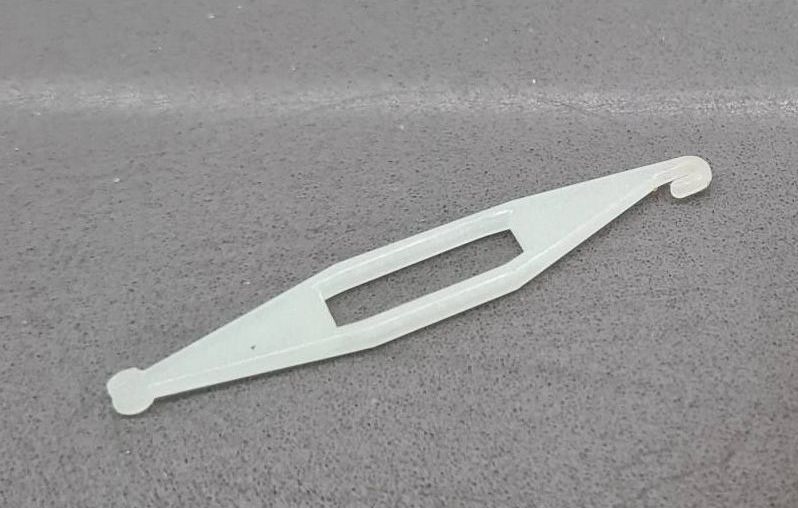
There’s also a special tool for putting elastics on. Personally, I found it harder with the tool and gave up after a day or two, but lots of people swear by it. More about it, and where to get one, in my top aligner tips.
How often should you change aligner elastics?
Some orthodontists want you to use fresh elastics every time you take your aligners out; others say at least twice a day, morning and evening. I changed my aligner elastics twice a day, as my orthodontist recommended.
Why so often? Because aligner elastics tire out fast. In one study with patients, latex elastics lost about half their force within the first 4–5 hours in the mouth, and kept weakening after that. So yesterday’s elastic is barely doing anything.
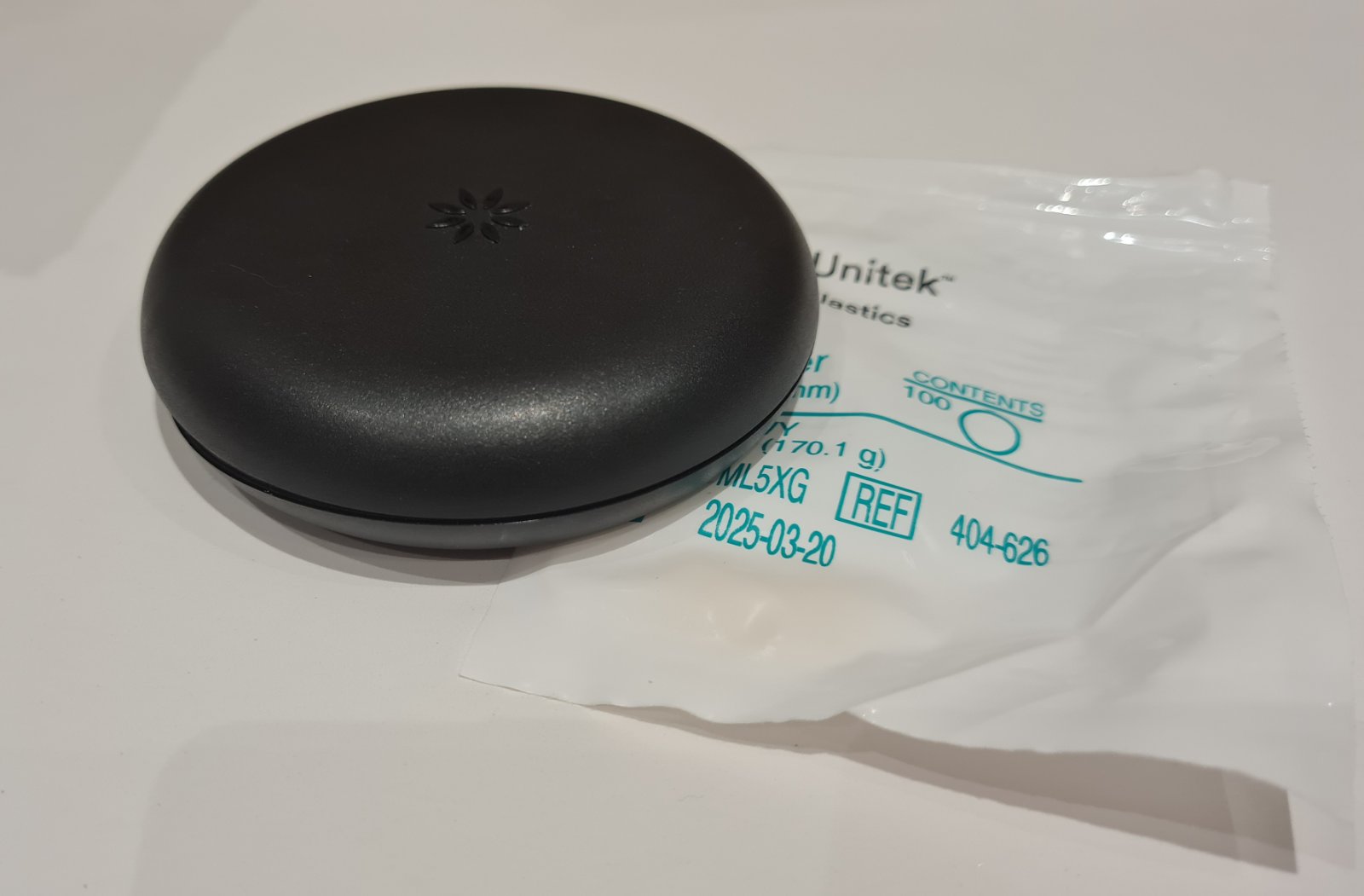
Change your elastics at least once a day, ideally morning and evening. Always carry spares – in your bag, in the car, at work.
Aligner elastics are worn whenever your aligners are in – usually 20–22 hours a day. They only come off for eating and brushing. Skip them and your bite simply doesn’t move, and treatment drags on.
Do elastics hurt?
For the first few days with aligner elastics, your jaw feels a bit worked, a little like after chewing for a long time. That’s normal and it passes. But be careful: if you feel real pain or clicking in your jaw, tell your orthodontist straight away. For me, elastics caused exactly that in my first plan, and my orthodontist stopped them immediately and made a new plan – more in my Invisalign experience.
A bit of jaw tension in the first few days is normal. Pain or clicking in the joint isn’t. Call your orthodontist.
Lost button, snapped or swallowed elastic?
- Snapped elastic: just put a new one in. That’s why you always carry spares.
- Swallowed elastic: happens to everyone and it’s nothing to worry about – it’s tiny and simply passes through. 😅 Put a new one in and carry on. (Only if you start coughing hard and it won’t stop, see a doctor.)
- Button came off: not an emergency, but call your orthodontist. Without the button, the elastic has nowhere to hook and your bite stops moving.
- Running out of elastics: ask your orthodontist for more in good time, not when you’re down to the last one.
Sources
- Qodcieh A. et al. (2017). Force degradation of orthodontic latex elastics: an in-vivo study. American Journal of Orthodontics and Dentofacial Orthopedics.
- Ptáčková et al. (2025). Force degradation of intermaxillary latex elastics: comparative in vitro and in vivo study. Clinical and Experimental Dental Research.
- Expert consensus on the clinical strategies for orthodontic treatment with clear aligners (2025). International Journal of Oral Science.

Leave a Reply
You must be logged in to post a comment.