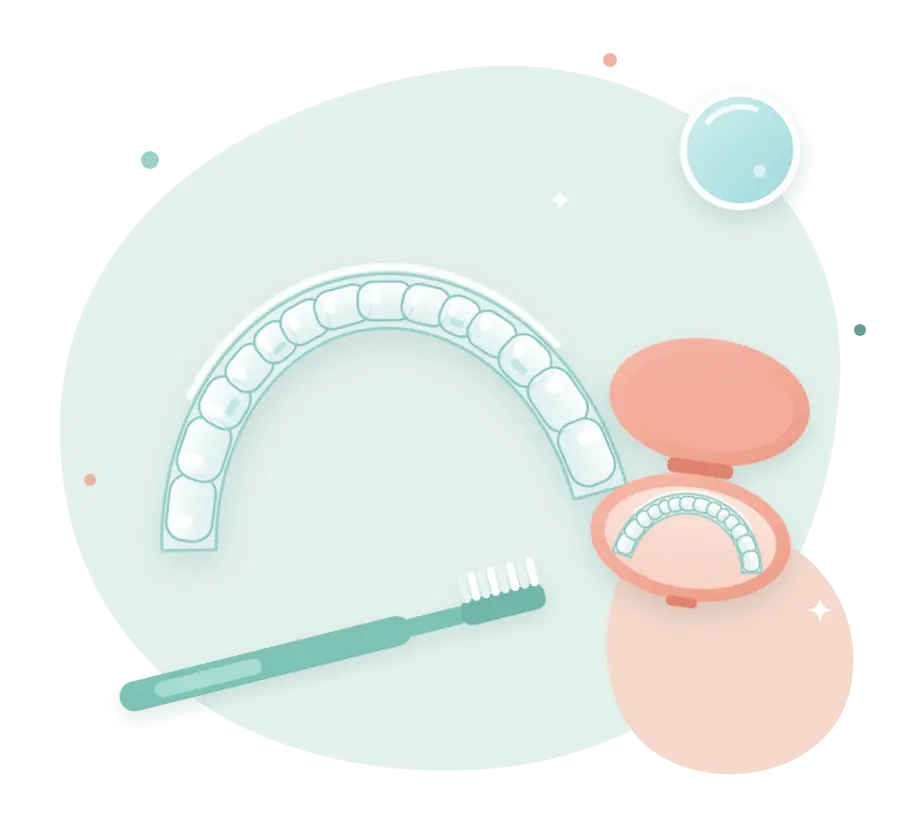
Once you start treatment, brushing teeth with aligners gets a little more complicated. Your teeth shift, new gaps appear between them, and food gets stuck in places it never used to. Here are the things that made daily cleaning easier for me during my treatment.
You’ll find out when and how often to brush, whether an electric toothbrush is worth it, what to use between your teeth and whether you need mouthwash. You can read more about my whole treatment in my Invisalign experience.
Contents
In short: brush twice a day for about 2 minutes with a fluoride toothpaste. After eating, clean your teeth before you put your aligners back in, so no food gets trapped underneath. Interdental brushes work best between the teeth, while floss and a water flosser are good extras.
| What | Tip |
|---|---|
| Brushing | Twice a day for about 2 minutes, once just before bed |
| After eating | Clean your teeth before putting your aligners back in |
| Toothpaste | With fluoride – at least 1,350 ppm for adults |
| After brushing | Spit out the toothpaste, don’t rinse with water |
| Between teeth | Interdental brushes or floss |
| Mouthwash | Alcohol-free, and not straight after brushing |
Brushing teeth with aligners: when and how often?
The basic rule is the same as without aligners: brush twice a day for about 2 minutes, and make one of those just before bed. Use a fluoride toothpaste – at least 1,350 ppm for adults (you’ll find it on the tube). Afterwards, just spit the toothpaste out and don’t rinse with water. That way the fluoride stays on your teeth for longer and keeps protecting them.
The difference with aligners is that they cover your teeth almost all day and night. If you put them back over teeth with bits of food on them, that food stays pressed against your teeth for hours. So after eating, it’s a good idea to clean your teeth before you put your aligners back in. If you can’t, at least rinse your mouth well with water.
Electric or manual toothbrush?
I’d wholeheartedly recommend an electric toothbrush. Mine was a Philips sonic toothbrush. If you’re going to be brushing often and for a long time, it’s an absolute lifesaver. The first time I used it, it felt as if I’d never properly brushed my teeth before.
Research backs this up. According to studies from 2014, after at least 3 months of using an electric toothbrush there was about 21% less plaque and about 11% less gum inflammation than with a manual one. That said, a manual toothbrush does the job too, as long as you brush carefully and for long enough.
What should you use between your teeth?
As your teeth start to move, annoying gaps appear between them. For me, interdental brushes were the only thing that really worked. I bought ones with an angled handle from DM, which made it much easier to reach between the back teeth. I had a few different sizes, and the pack came with a little cap to keep the brush clean. The brush should fit snugly between your teeth, but never force it.

The other option is dental floss. As much as I disliked it, sometimes there was no way around it. I used disposable floss picks from DM, but not very often – I preferred interdental brushes. According to studies from 2019, interdental brushes reduce gum inflammation more than floss.

Is a water flosser worth it?
A water flosser sprays a strong jet of water between your teeth. You fill the tank with water (you can add a little mouthwash), aim the jet and it rinses out the gaps. It’s gentle on your gums and leaves your breath fresh.
I used a water flosser too – it’s really pleasant and convenient. But for food that’s properly stuck between your teeth it just isn’t powerful enough, so in those cases I reached for interdental brushes. Research agrees: according to studies from 2019, water flossers do reduce gum inflammation, but the evidence is weaker than for interdental brushes.
Do you need mouthwash?
At the start of my treatment I had a really unpleasant dry mouth, and mouthwash made it even worse. Then I read that it’s better to use an alcohol-free one. There are also mouthwashes for sensitive teeth, which help at the beginning while you’re getting used to your aligners.
Don’t use mouthwash straight after brushing, as it washes away the fluoride from your toothpaste. Use it at a different time instead, for example after lunch. Then don’t eat or drink for 30 minutes.
How did I clean my teeth?
At first I brushed my teeth after every meal. After a while, though, I got fed up with it, and after lunch I’d just go over my teeth with an interdental brush 🙂
Don’t forget that the aligners themselves need regular cleaning too. Here you can read how to clean your aligners. For more handy tips, see my aligner tips.
Sources
- NHS. How to keep your teeth clean (reviewed 30 June 2025).
- Yaacob M. et al. (2014). Powered versus manual toothbrushing for oral health. Cochrane Database of Systematic Reviews, CD002281.
- Worthington H. V. et al. (2019). Home use of interdental cleaning devices, in addition to toothbrushing, for preventing and controlling periodontal diseases and dental caries. Cochrane Database of Systematic Reviews, CD012018.

Leave a Reply
You must be logged in to post a comment.