
I started the “Conversations with orthodontists” series in March 2023 with my favourite orthodontist – Dr Neli Dilkova, who also treated me. At the time of the interview she was a Diamond Invisalign Provider. She has countless happy patients and was kind enough to answer questions asked under a post in my Facebook group. You can read more about her work on her website.
Here are her answers – on complex cases, treating children, retainers and what not to do while wearing aligners.
Contents
Can aligners treat a crossbite, open bite, deep bite or an impacted tooth?
Every kind of malocclusion can be treated with both aligners and braces. Depending on the patient’s age and the condition of the bone, the treatment has to be planned properly. Braces and aligners are tools that achieve the same thing, so in every case the tooth movements need to be planned carefully, including whether any teeth need to be taken out.
If the crossbite is skeletal and the patient has stopped growing, surgery is usually needed as well. Pulling down an impacted tooth always requires additional devices – mini-implants and others – with both braces and aligners. So anything is possible with either type of appliance, as long as the movements are planned appropriately and precisely.
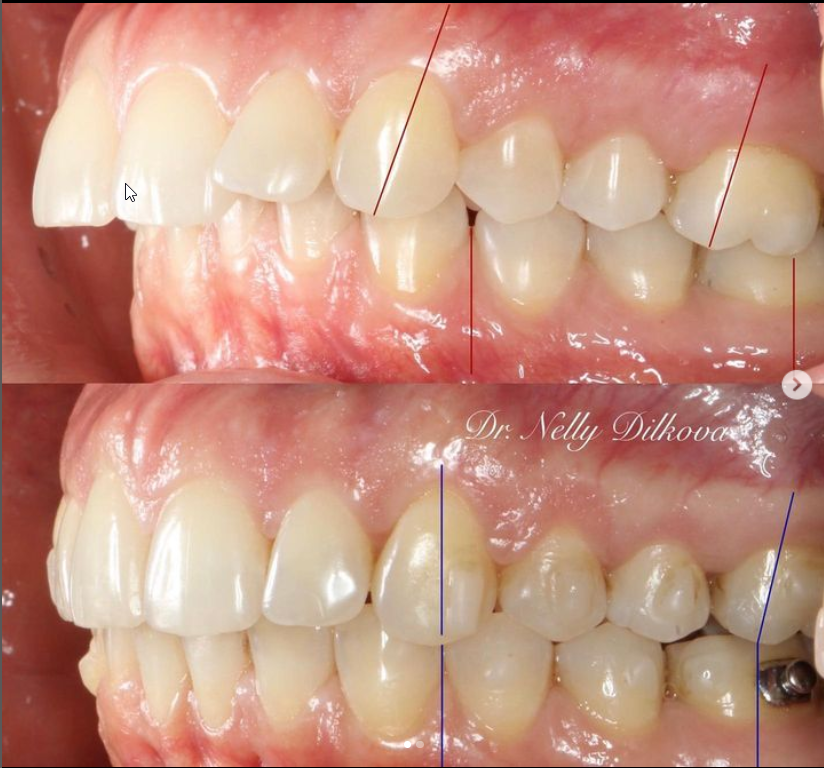
In the photo: correction of a bite problem – a Class II, deep bite with a gap between the upper and lower teeth – in a patient who has finished growing. The treatment was carried out by Dr Neli Dilkova with aligners, with final refinements left before the retention phase.
Is it true that aligners are only for mild cases?
No, that’s not true. There are no unsuitable cases – sometimes treatment is just more difficult. That applies to aligners and braces alike. An example of a complex case is moving the back teeth a long way forward; then mini-implants need to be added.
There are also things that can’t be treated with braces or aligners alone – for example, a very narrow upper jaw that needs skeletal expansion (editor’s note: widening of the jaw). In those cases you can’t use aligners or braces alone; they always need to be combined with other methods.
Are aligners always fitted on both jaws?
I don’t like treating just one jaw, because the bite involves both. Sometimes, even if we see only one crooked tooth, we have to manage the position of the teeth in the other jaw so that it can line up properly.
As an exception, if there’s relapse – when teeth move back after orthodontic treatment, for example because wisdom teeth have come through or retainers weren’t worn enough – the correction may be in one jaw only.
Very rarely, I treat only one jaw if the patient doesn’t want their bite corrected and is only bothered by one tooth. They then sign an informed consent form confirming that they don’t want the bite corrected, only that specific problem. Everyone makes their own informed choice, especially in adult orthodontics.
Can aligner treatment harm patients with receding gums?
No, it can’t. With proper planning and imaging (CBCT, editor’s note: a 3D X-ray), we can see where there’s enough bone so that we don’t go beyond its limits. When bone is lost, the gum recedes too. In patients with gum disease (editor’s note: disease of the gums and the bone around the teeth), aligner treatment must always be combined with very good periodontal care.
Aligners, like any orthodontic treatment, improve periodontitis when planned correctly, because we change the relationship between the tooth and the bone. With aligners we can reduce the forces for these patients, which makes aligners very suitable for them – and it also makes it easier for them to keep their teeth clean.
Can you pay in instalments?
Yes, with me treatment is always paid in instalments. Depending on whether we’re treating children or adults, there’s a set initial payment and the rest is spread out.
How early can aligner treatment start, and is it quicker and cheaper for children?
Treatment in children usually starts at around 7–8, when the first permanent molars and most of the incisors have come through. In general, children’s treatment starts as soon as a problem is spotted. If a 4–5-year-old has a crossbite, it can be treated even then, with appliances or aligners.
This stage is important – in most cases the jaws need to be widened – and it sets things up for a shorter and lighter phase 2. That doesn’t rule out further treatment if the child has a bite problem; we can’t control how the teeth will come through.
This first phase takes about a year. Then there’s a retention period, after which we watch how the teeth change. Sometimes phase 2 can be avoided if the teeth come through nicely and we’re lucky. And yes, phase 1 is cheaper than treatment for teenagers and adults. If phase 2 is then needed, it’s cheaper than starting treatment as a teenager.
More about two-phase treatment for children
Does aligner treatment cause more tooth decay in children?
Aligner treatment in itself doesn’t cause decay – any orthodontic treatment could. If children wear appliances without brushing first, food can get trapped around hooks, plastic and other parts and cause decay. If anything, aligners make them more motivated to follow the instructions. Children are my most conscientious patients.
What happens after treatment ends?
Retainers are fitted. This is the most important and responsible period, and it depends largely on the patient. Retainers can be fixed, removable or a combination. Fixed ones are a must for patients with gum problems, where there were large gaps before treatment, with severe crowding, or when teeth were taken out – premolars, for example. After that I always like to add a removable one too, because we’ve changed the whole shape of the dental arch and this is how we keep it. A fixed retainer only holds the teeth from canine to canine.
The removable retainer means that even if something comes unstuck after treatment, the patient can put it in and hold the position until the retention phase is over. This phase ideally lasts for life, but its intensity changes gradually. For the first year they’re worn every night, then less and less. It’s advisable to wear them 1–2 nights a week if we also want to avoid the natural changes in the teeth that come with age.
How long after treatment does the bone recover and the teeth become relatively stable?
That depends a lot on when treatment starts. I like to start treatment earlier, because that way the teeth settle as the child grows and they’re much less likely to move back afterwards.
When treatment starts later, this period is slower. The soft tissues recover within a few months and the bone generally recovers in about 2–3 months, but the teeth should be relatively stable about a year after treatment.
What happens at the end of treatment if bonding is needed? When are retainers fitted?
What we do is fit rigid retainers straight after treatment, and if the patient wants to whiten their teeth, we make whitening trays. Then the restoration – the bonding – is done. We try to finish one jaw in a single day, and after each procedure we make so-called transfer retainers – temporary retainers that hold the result the whole time. When everything is done, a permanent, fixed retainer can be placed the same day.
Can aligners be cleaned in an ultrasonic cleaner?
In general, high temperatures aren’t suitable for aligners – they can’t take heat. You can use ultrasonic cleaners made specifically for dental use, which don’t heat the water to high temperatures.
What shouldn’t we do while wearing aligners?
With aligners in, you should drink only cool water. You can smoke and drink coffee, as long as it isn’t hot, but there’s a risk of staining. It’s best to avoid staining foods and drinks, anything hot, and cola; everything else is fine with them. Sometimes, when there’s a crossbite and the teeth don’t meet properly without aligners, I even recommend eating softer food with one of the aligners in.
More about the most important things when wearing aligners
Many thanks to Dr Dilkova for her answers! And my own aligner story is in my Invisalign experience.

Leave a Reply
You must be logged in to post a comment.