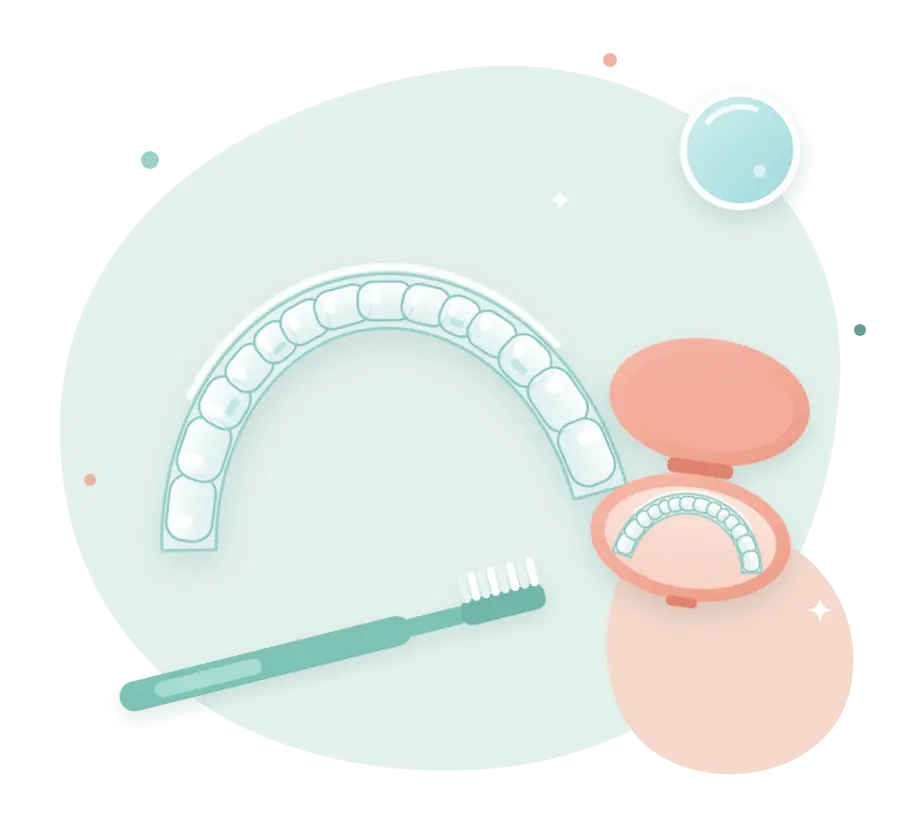

Attachments are the part of aligner treatment other people actually notice. Without them, the trays are almost invisible. But hardly anyone gets through treatment without them, so they’re a necessary evil. 😅 Most of us are genuinely terrified: will I have them, will they be on my front teeth, how many, how big, will people see them? And most importantly: what will they do to my selfies! Because you can take your aligners out for a photo, but attachments stay stuck on until the very end.
Don’t panic. I had attachments on almost every tooth, two each on my upper front teeth, and they were far less noticeable than I feared. Here’s everything you need to know.
Contents
What are attachments?
Attachments are small tooth-coloured bumps made of composite, the same material used for white fillings. They’re bonded onto your teeth and come in different shapes depending on which way a tooth needs to move and how much force it needs.
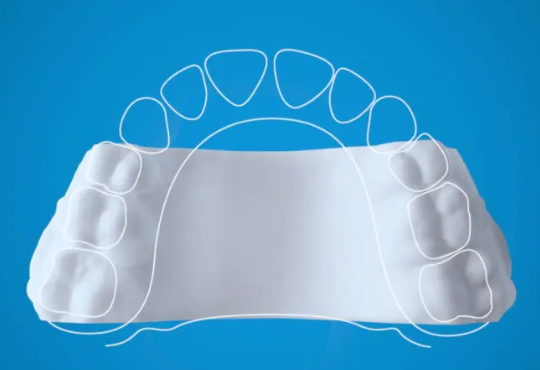
Why do you need them? A tray on its own is smooth and struggles to grip rounded teeth. Attachments act like handles that the aligner can hold on to, so it can rotate, pull or tip a tooth. Rotating canines and premolars, and moving a tooth up or down, are especially hard without them. Your aligners have little pockets exactly where the attachments sit, and every tray after that is made to fit them.
An aligner with pockets for attachments (the small raised squares):

Attachments aren’t decoration: they’re the “handles” your aligners use to move your teeth. Without them, many movements simply don’t happen.
How are attachments put on? Does it hurt?
It doesn’t hurt. Along with your aligners, your orthodontist receives a special template tray for the attachments. They clean your teeth, apply a bonding gel, fill the template with composite, place it over your teeth and set it with a blue curing light. Then the template comes off and the attachments stay on your teeth. Finally, any excess material around them is smoothed away with a small polisher. It isn’t unpleasant.
I had attachments on every tooth except my four lower front teeth, and putting them all on took less than an hour.
For the first few days, attachments feel a bit sharp, and you get the odd feeling that something is stuck to your teeth and won’t come off. You get used to it fast. After putting your aligners in and out a few times, the sharp edges smooth down and you stop noticing them. If one is rubbing your cheek, a small piece of orthodontic wax helps.
Your first tray with attachments grips a lot tighter and is harder to take out. That’s when a removal hook becomes your best friend – more in my top aligner tips.
Take your aligner out from the back teeth first, and don’t press hard on the attachments: they can sometimes come unstuck or chip.
What do attachments look like?
Here’s a photo of my teeth without and with an aligner:

They’re most visible when your aligner is in. A tiny bit of air and saliva gets trapped around each attachment inside the tray, and that’s what makes them stand out, like little shiny bubbles. Without the tray, they’re less noticeable because they match your teeth.
Press your aligner in firmly with your fingers or a chewie so it hugs the attachments tightly. The less air trapped inside, the less they show.
How many attachments will I have?
It depends entirely on your treatment plan. Mild cases may have just a few or none at all. More complex cases, like mine, can have them on almost every tooth. Your orthodontist will show you exactly where they’ll go and what shape they’ll be in your 3D plan (ClinCheck for Invisalign). If one on a front tooth bothers you, ask: sometimes the shape or position can be changed.
In most packages, attachments are included in the treatment price – more in clear aligner cost in Europe.
What if an attachment falls off?
It happens, especially with hard food or when taking your aligners out. It’s not a disaster, but don’t leave it too long: without the attachment, the tray may stop moving that tooth properly and it can fall behind. Call your orthodontist. They usually re-bond it at your next appointment, or sooner if it’s an important tooth.
Do attachments stain?
They can. Composite picks up stains from coffee, tea, red wine and curry more easily than enamel, especially if you drink those with your aligners in. So drink your coffee without your trays, or at least rinse afterwards, and brush regularly.
If you want to whiten your teeth, wait until treatment is over. Whitening doesn’t lighten composite, so if you whiten during treatment, you may end up with darker patches where the attachments were once they come off.
Whitening only after your attachments come off. Otherwise you risk spots in your old tooth colour where they used to be.
Are attachments removed at the end?
Yes. At the end of treatment (and sometimes before a refinement), your orthodontist removes them. Some carefully grind them off with a polisher, while others first pop them off with special pliers and then polish away what’s left. Either way, it doesn’t hurt, it takes a few minutes, and your teeth are left as smooth as before. Lab studies show that with the right polishing tools, enamel loss is minimal – less than 0.02 mm.
Some orthodontists remove attachments before every refinement and put them back on afterwards; others leave them in place. Ask yours how they do it: with lots of refinements (I had 6 plans 😄), it’s good to know in advance.
Still deciding on treatment? Read aligners vs braces.
Sources
- Pandian, Subramanian, Vaiid (2025). Comparison of efficacy and accuracy of tooth movements in optimized and conventional attachments of clear aligners: a systematic review and meta-analysis. Journal of Oral Biology and Craniofacial Research.
- Nguyen, Nguyen (2025). Evaluation of enamel integrity after clear aligner attachments removal: a risk–benefit comparison of one-step tools. PeerJ.
- Haouili N. et al. (2020). Has Invisalign improved? A prospective follow-up study on the efficacy of tooth movement with Invisalign. AJODO.

Leave a Reply
You must be logged in to post a comment.